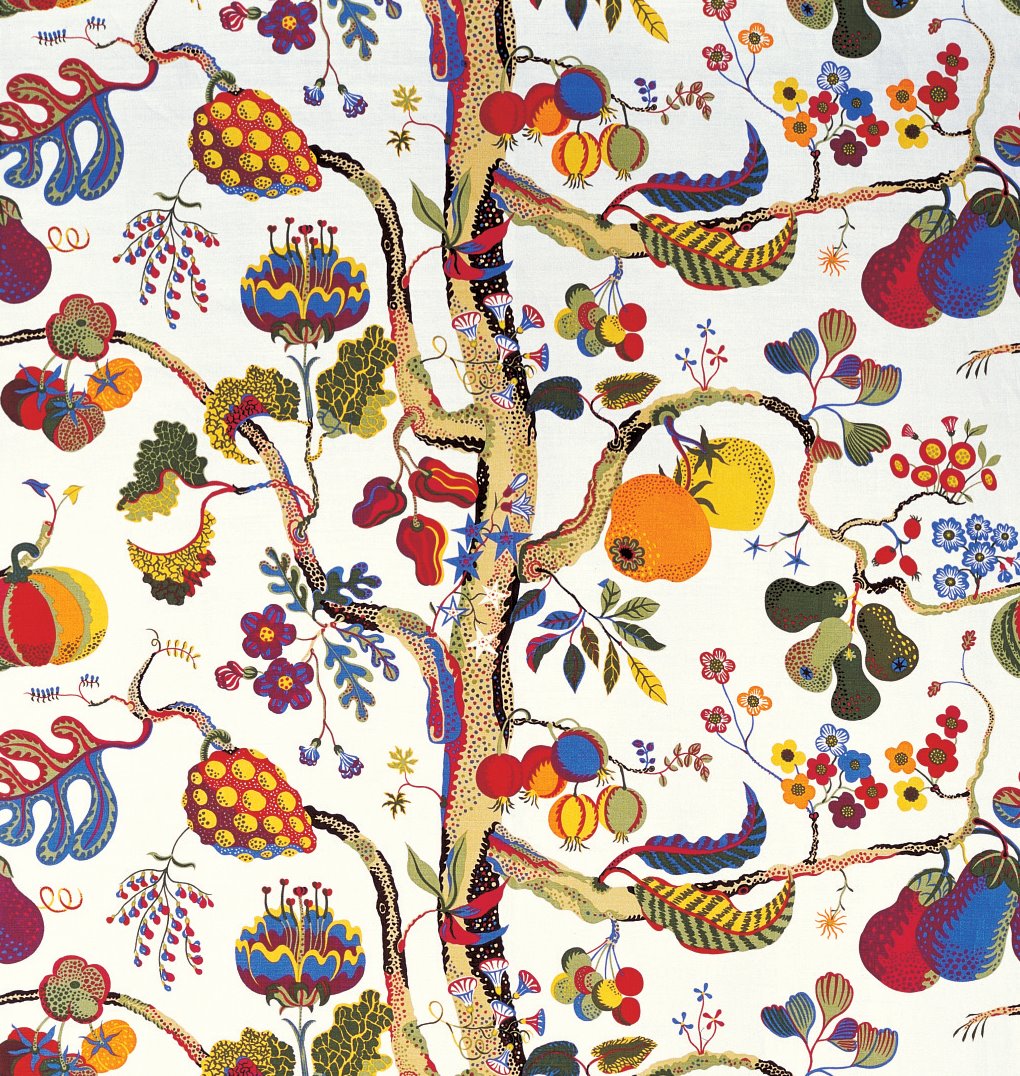
Os hablaré de algo que siempre cuento y que creo que caracteriza nuestro trabajo, el amor por la artesanía y las artes aplicadas. Cualquiera que nos siga en redes sociales sabe cómo nos influencia el arte, la creatividad... pero por encima de todo siempre tratamos de poner en valor el trabajo anónimo artesano que ha decorado casas, habitaciones, prendas, textiles y utensilios durante miles de años en todas las culturas. La artesanía para nosotros es una suerte de inteligencia colectiva, de expresión humana sin individualismo y que normalmente se infravalora y se menosprecia.
Siempre he pensado que mucho de lo que los artistas han hecho durante las vanguardias e incluso en la actualidad, y que tiene y ha tenido tanta repercusión y alabanzas en nuestra sociedad, está inspirado -o directamente ya existía- en la artesanía o en el diseño textil. La abstracción, los juegos de colores, la composición... y también la expresión de emociones, estados de ánimo, culturas y creencias, todo está ahí, en las pinturas de muros, en las mantas que arropan, en el ganchillo o técnicas complejísimas cómo el shibori, en el patchwork o las almazuelas, en la cerámica, en la madera...
Una vez oí al genial Isaac Diaz Pardo, creador de Sargadelos, hacer una reflexión interesante. Estaba ante una talla de madera, una escultura, y decía algo así: "supongan que ésto es un crucero, un crucero tallado por un carpintero, entonces estaríamos antes una obra de artesanía, ahora, si éste supuesto crucero lo hago yo, que soy un titulado de bellas artes, entonces ya ésto es una obra de arte. Se quiere hacer una división del que hacer humano entre la cultura y el resto, cuando la cultura lo es todo, todo lo que crea e idea el hombre es cultura"
Esta reflexión es interesante ya que pone de manifiesto que hay una distinción de clase entre algo diseñado y producido por alguien que es artista y alguien que no lo es, o no está titulado o no se señala como artista...hay una distinción de clase. Pero yo añadiría algo más, creo que además hay una distinción de género, y esto, en el téxtil, es brutal.
I just
come from university where I gave a lesson about pattern design. The funny
thing when I try to explain something to the students is that I also learn in
the process , I mean, I find myself thinking outloud on some disorganized stuff
in my head, thoughts that come to an
order when I try to explain them. And I thought it would be a good idea to
share this thoughts with you all…There I go...
I´ll talk
now -as I´ve already done before- about
our work and our love for crafts and decorative arts. Anyone who follows us on social media knows how important is for us art,
creativity, imagination… but above all we try to value the anonymous craftwork
behind the decoration of our homes, our domestic tools, our blankests, our carpets, our clothes. We
consider craft as a kind of collective intelligence, as a sort of human expression
without individualism, as something we value a lot even thoug it is normally infravalued by people.
I´ve
always thought about the role of artists and the avangardes, and I kind of feel
that all they´ve made it was already done in one way or another by crafters.
Abstractions, play of colors, compositions, the expression of emotions,
moods states, cultural simbologies or beliefs, all was already there on the work made
by crafters, on the wall paintings, on shibori techniques, on the patchwork quilts,
on potery and so on.
Once I heard
genius Díaz Pardo –Sargadelos creator- making a interesting point when
contemplating a wood carving, he said something like this: “imagine this is a boat, a boat carved by a
carpenter, then we would be standing in front of a craft piece. Now image that the piece has been realized by me or
someboody like me, with a fine arts degree, then we´d be talking about a piece
of art. We tend to make an artificial separation between craft and art, between
high and low culture, when it is all cultural, everything men do”.
This is
an interesting reflexión because it
makes clear the existence of a class divide when it comes to consider what is
art or art is not. Art is what the class of artists make and craft is what crafters
make. But there is also another pertinent división to signal: the gender división,
so clear and observable in the textil industry


Dentro de la artesanía el arte textil ha sido y es mayoritariamente femenino y, según mi percepción, esto lo ha situado por debajo incluso de otras artesanías y artes. La mujer ha sido menos que el hombre a lo largo de la historia y su trabajo también ha sido despreciado y minusvalorado. Existe una idea heredada en nuestras mentes de que el trabajo textil es algo de chicas y algo menor. Os voy a poner algunos ejemplos. Cuando yo estudiaba arquitectura empecé a hacer ropa a la vez, estaba en cuarto o quinto de carrera cuando uno de mis profesores de Proyectos me dijo, "tienes mucho talento para la arquitectura, no pierdas el tiempo con eso de hacer vestiditos". En ese momento sentí la necesidad de defender lo que para mí significaba "hacer vestiditos" pero no supe cómo hacerlo. Había en el aire una idea clara: la arquitectura es un arte mayor, una cosa que han hecho los hombres, una cosa importante, mientras que hacer ropa (vestiditos) es una cosa menor, una cosa femenina, una cosa superflua (aquello me recordó a la Bauhaus donde las mujeres sólo podían diseñar textil y telares mientras los hombres hacían arte y arquitectura, mientras que dirigían la escuela y decidían que lo menor era el téxtil y lo mayor la arquitectura y el arte)
Lo que descubrí con el tiempo y el estudio es que la ropa no es algo menor, no, es algo básico, un lenguaje, parte de nuestra comunicación, nuestra segunda piel y nuestro abrigo, la envolvente más próxima y algo a lo que el ser humano ha dedicado siglos de cuidado estudio y desarrollo. Descubrí que los tejidos encierran miles de años de conocimiento tecnológico, la selección de fibras, la torsión de los hilos, las búsqueda de materias primas, los tintes, las distintas técnicas y formas de unir hilos y piezas..., botones, cremalleras, corchetes, jacquares, bordados...todo ésto ha requerido de brillantez, creatividad e ingenio. Las prendas que llevamos son además contadoras de historias, comunicación absoluta, lenguaje visual que habla de nuestra forma de ser, de si somos prácticos, de si somos estetas, de si queremos pasar desapercibidos, de si necesitamos captar la atención de otros. Las prendas hablan también de nuestro estatus, son una herramienta poderosa simbólica, narrativa y mágica.
Within
crafts, textil has been mainly femenine. And as far as I can see this is the
reason why textil is considered a minor art and craft. As we all know women has
been the lower class of history and this is why the productions of women has
been despised and infravalued systematically.
There is a inherited idea in our minds that textil work is girly and minor.
When I was studying architecture in university I started to design clothes at
the same time and I encountered this teacher who told me not to lose my time
doing dresses. In that precise moment I felt the urge to defend what those
dreeses really meant to me but I did not find the way to do it. What I learnt
from this was that there is a dominat idea: architecture is an art with capital
letters, a very important activity donde by men, while doing dresses is a minor thing to do, something femenine, superflous and vain (that
remembered me of the Bauhaus, that school run by men where women were only
allowed to engage in textil design while men were doing big art and architecture)
What I
learnt later on after many good readings is that clothing is not a minor thing. It is something basic, it is a language,
communication, our second skin, something to which humans have dedicated centuries to
study and develop. I found out that clothing carries thousands of years of knowledge on how to obtain yarns out of plants or wool , lots of knowledge in order to develop so many different techniques, so much knowledge about the composition
and behaviour of fabrics, plenty knowledge on how to dye fabrics using natural products and so on. All of this has required a lot of creativity and
intelligence. The garments we wear also tell stories, they communicate who
we are, or who we want to be or where do we belong in terms of status. The way
we wear says a lot about our origins and about our personality. You can tell if somebody is either a practical
character or an asthete, a timid or a poser by the way he dresses.


En la evolución, el hombre y la mujer comenzaron a vestirse para comunicarse, no para abrigarse como la mayoría cree, Una vez perdieron el pelo corporal pasó casi un millón de años, según recientes teorías, hasta que empezaron a vestirse, y no tanto por cuestiones de temperatura como con cuestiones que tienen que ver con la comunicación. Así, los atuendos servían a los hombres para contarse cosas, para señalar su estatus, para atemorizar al contrario a la hora de pelear. Así surge la vestimenta como un lenguaje que se ha desarrollado a lo largo de la historia de la humanidad hasta nuestros días.
In
evolutionary terms humans began to dress not so much -as everybody belives- to protect themselves
from wheather conditions but to
communicate with each other. Once our bodies lost hair – and acording to recent
theories- we were during almost a million years still naked, and then we
started to get dress as a tool to communicate, to signal status, to frighten the enemy, to celebrate rites and so
on. This is the way in which clothing came to life, and the reason why it is so important, because it is so attached to our cultural evolution .


La confección de la ropa ha tenido tradicionalmente lugar en los hogares, en el espacio doméstico, y ha sido llevado a cabo por mujeres...y esto ha hecho que haya sido un trabajo menospreciado y que todavía hoy de alguna forma siga siéndolo.
Cuando comencé a hacer ganchillo me dí cuenta de todo el conocimiento e ingenio necesario para crear cosas con esa técnica; me dí cuenta del trabajo exquisito, detallado y las horas de estudio que requería hacer, por ejemplo, las colchas que hacía mi abuela; me dí cuenta de lo que nos habíamos reído en casa con su trabajo, tan admirable, tan respetable y tan necesario como el de un hombre haciendo casas o puentes.
En diseño textil o de ropa lo que hay y habrá son creadores geniales, regulares o mediocres, igual que en arquitectura habrá arquitectos geniales, regulares y mediocres, pero en ambas cosas siempre hay alguien aportando, creando, inventando, y siempre hay gente con menos ideas o con más oficio que creatividad etc... Pero todo es parte de nuestra cultura, parte de lo que el hombre crea para bien o para mal, parte de su expresión, de su lenguaje y de su imaginación. Nos parece que hay cosas que son más complejas que otras y ahí es dónde creo que hay ese sesgo de género, dónde lo que ha realizado el hombre es complejo y valioso y lo que ha realizado la mujer sencillo y menos importante. Pero sólo hay que ver cómo teñían usando plantas, insectos o piedras, cómo hilaban, cómo tejían y como ideaban composiciones creativas para darnos cuenta de la complejidad del diseño textil.
Bueno, hago esta reflexión también como excusa para mostraros cosas fascinantes que ilustran el texto y para poner en valor el trabajo de miles de mujeres en el anonimato de sus casas creando y componiendo con hilo de colores, aprovechando tejidos para hacer patchwork abstracto mucho antes que Kandinsky, haciendo y diseñando motivos de todo tipo, inventando el surrealismo antes que Dalí, aprendiendo técnicas dificilísimas llenas de paciencia, hilando fibras naturales, estudiando la mejor forma de unir tejidos o la mejor forma de conseguir abrigo y belleza. Y siempre sin buscar ni obtener demasiado reconocimiento.
Podéis ver el origen de estas fotos en esta carpeta de Pinterest entre otras muestras de trabajos textiles tradicionales.
Clothes
production has taken place traditionally at home, in the domestic sphere, and
it has always been considered as a women task. When I started knitting I realised
how tricky it was and I began to think about all the delicate work and time embedded in any of the counterpanes my
grandma had done during her life. I sadly remembered how much we despised and
laughed at her work, a work as admirable, respectful and necessary as any of the
work men usually do.
In the textil
design or garment design world there is diversity: there are great designers and regular designers and awful designers, and the same happens in any realm
of life. All those designers made a
contribution to culture, all there is is culture as a byproduct of human activities.
There are designers with nice ideas and designers with skills to put them into
practice, designers experimenting and trying things and designers who look deep
into traditions. And those designers are creating culture, making a language for us to express
ourselves.
We tend
to think there are some things more complicated than others, and we also tend to
link complexity with men activities. And this is where we can clearly see the gender bias: Men work has to do with complexity and value
and women work is considered simple and less valuable. But we just have to
carefully watch women works in the textil history to undestand how wrong we are
when we scorn and underestimate women productions. To understand that complexity
is not men property just consider the complicated knitting techniques women have been using
and developing, just have a look on the marvellous compositions of quilts, just
apreciate the tricky work behind dying fabrics out of plants, roots and
fruits..
To talk
about gender issues on the textil industry is also an excuse to show you
amazing stuff that illustrates the text. It is time to put in value the
fantastic work of thousands of anonymous women at their homes learning very
difficult knitting or sewing techniques, recycling cloths and rags to make some
abstract patchwork before Kandisky, inventing surrealism before Dalí,
spinning natural yarns, studying the best way to attach one piece of fabric to
another in order to get both beauty and funcionality. Usually humble women at work,
women that did not get much recognition.
You can find out more about the origins of
these pictures in this
folder on Pinterest and many more cool images…